I have no greater joy than to hear that my children are walking in the truth. 3 John 1:4

Showing posts with label science. Show all posts

Friday, January 31, 2020

Early Morning Birding With Friends

 Bird watching is one of our favorite things to do during the cooler winter months here in Florida

.  Although our main intention is always to watch the birds, study their habits, discover new and never-seen species...  we always come home with more than what we intended. We find surprising colonies of certain types, like on a trail we visited at Wekiva Springs State Park not too long ago.  We saw many varieties of woodpeckers, and a disheveled Yellow-bellied Sapsucker that was number 178 in my Life List! 

Today at a trail near Lake Jesup, we recorded eighteen species, nothing unusual.  Emily and I met our friends for an early morning hike.  We had a great time even checking out all the interesting tracks left behind in the mud - raccoon, some large bird tracks, deer, and maybe even a bear... although I think that one belonged to a big dog.  On our way out we heard the distinctive growl of a gator only a few feet away from our trail.  We didn't linger...   I learned this morning that Lake Jesup has a history of being the place where nuisance gators get dumped from all over the state.  No wonder there were warning signs about gators and snakes by the trailhead. 


Birding - a science field trip and a nice way to start the day and spend time with friends!

Monday, November 7, 2016

UF Law & Florida Natural History Museum


Last weekend, we took a trip up to Gainesville and visited the Florida natural History Museum at the University of Florida.  They had several interesting exhibits there, but what we really liked the most was the butterfly garden and immense collection of butterflies from around the world.


Not only was the size and diversity of the butterflies in the garden impressive, but so were all the beautiful plants.  This could also be called an enclosed botanical garden...  


We all enjoyed this part of the museum very much.


Another reason for the trip was Michael's interest in UF Law.  He went to an orientation type lecture, got to speak with current students and admissions advisors, and got a tour of the campus.

**Fall 2017 update - Michael was admitted to UF Law with a FULL SCHOLARHIP -- Way to go, Michael!!!

One of the many cases on display, beautiful!

Friday, July 22, 2016

Apologia Biology

Michelle is finishing up with biology for the year.  She did very well and enjoyed even the disection labs.  It was revealing for me to watch her and see that she's a natural at the anatomy labs.  We may have found her gift!  This is so not my area... I had to steel myself several times when she couldn't find one of the organs, pick up the tool, and start moving parts... to show her the lungs which were buried in the back behind the liver, or some other such thing...  I am glad there are people who have this area of interest!

Thursday, July 3, 2014

Science Project - Birds!

Emily has been recording her bird sightings in the backyard in her journal this summer, building a nice collection of drawings and observations, and having lots of fun with it. 

This week, we installed our new bird feeders, and we've all been enjoying watching the birds which congregate around it, especially early in the morning and late in the evening. 

Our science curriculum for 2014-2015 will be Apologia's Flying Creatures of the Fifth Day.  So, out bird studies will extend through next year.
 
Living in Florida makes this project especially fun, as we have so many species to study year round.  Nevertheless,   I signed up for the Cornell University Birdfeeder Project starting this Fall.  We are also recording our logs on ebird, their amazing website where thousands of people from around the world contribute their sightings. 

Cornell has a number of projects and resources on their website:
All About Birds is an online guide to birds and bird watching. It provides information about birding basics, live video feed from bird cams, informational videos, and more.
There are also three free modules to download for teaching the scientific method and graphing data called Investigating Evidence.

For field trips this year, I have planned several outings to county parks, and one longer trip to the J.N. "Ding" Darling National Wildlife Refuge  on Sanibel Island.  We are blessed to live very close to one of the county's best bird habitats - Edward Medard Park.  There are birding groups organized each Fall which I hope to join with to learn more about bird watching, etc.

Thursday, June 12, 2014

Summer School II

I thought it would be fun to do a nature journal with some structure this summer, one which asks questions to help with observations.  I'm very happy to have found the Bird Log.  It comes with 30 log pages,  space for drawing,  and pages in the back where we can add photos or more colored pictures.
Emily is a great animal lover. She has been this way since she was a toddler, bringing bugs and frogs inside for me to admire, taking care of our pets...  she has been enjoying her Bird Log and going out to find and watch birds in the mornings.  I think it will make a nice keepsake for her.

Adventure Publications also sells a Nature Log, which I'm thinking of getting for next summer.

Thursday, July 19, 2012

Chemistry - The Periodic Table

I am working on Michael's chemistry lesson plans for next year, adding activities and projects to the regular Apologia Chemistry for an honors credit. I am using Donna Young's free coop lesson plans again this year.  We will use her free memory bookmarks for chemistry, like we did for biology last year.

I found a series of videos through our library about the history of the periodic table, a nice printable table, a blank one, and an interactive one from NOVA.

I may do an 'adopt an element' project like this one. He would do an element a week.  These links would be useful for this:

Interactive periodic table giving information about each element.


And just for fun!

The element's song
Element hangman
Element word scramble
Element crossword puzzles
3D Labs Online
Element Quest
Mystery Powder Lab

Thursday, April 28, 2011

Kinetic Books

I discovered a new math and science curriculum today - Kinetic Books.  I think I'm sold on them and can't wait till Michael takes Physics and Algebra II now!  The website says they are coming up with a Geometry curriculum "soon."   So, we'll see if we can use that next year.

4/29 -- Update!  I received a response this morning, they WILL have the Geometry book ready by beginning of this Summer.  I'm happy!  And, I'm impressed with their quick response too.

Monday, November 1, 2010

Learning About Bees & Honey

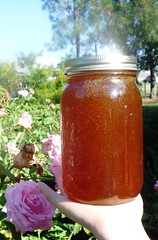
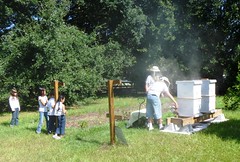
xhoney14The big excitement at our home the last few days has been our honey harvest of this weekend.  We got our first beehives back in April and had been anticipating the day we would get to taste their honey.  This weekend was it. 
xhoney4

We had friends over and made a fieldtrip out of it, and we are taking a  break from our regular science curriculum to work on a bee unit.

I found a complete, free honeybee lapbook at Homeschool Share. 

We watched Moody's City of Bees video and read library books about bees.
xhoney2

I had fun drawing on the board while explaining the parts of the bee and the shapes of the cells in the honey comb.  The girls used my board sketches to draw copy their own pictures for bee cover pages for their lapbooks.

lapbook

We also watched this nice video about queen bees.


Follow the link to read more about our honey harvest.

These are the books and video we used for our bee study.


Now you can go visit the Homeschool Chick's Hip Homeschool Hop and see what other homeschoolers are doing this week.

Monday, October 25, 2010

Science - The Circulatory System (BLood)

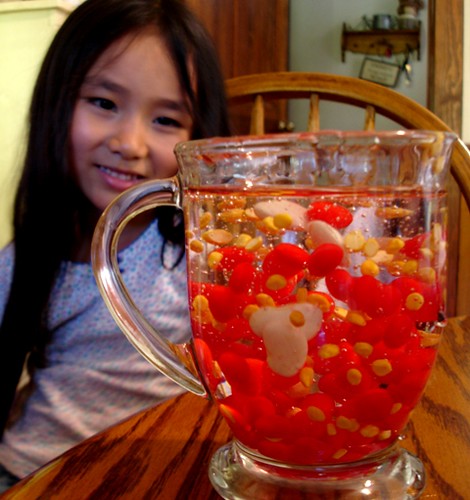
In our lesson about the circulatory system last week, the girls enjoyed a neat experiment that helped them learn the parts and functions of blood.

xblood

The large Red Hots candy pieces, lentils, and fava beans were perfect substitutes representing platelets, red and white blood cells.  Corn syrup held them all in suspention as blood plasma.  The experiment even caught the attention of my two older ones who happened to be around at the time. 

I'm linking with Hip Homeschool Hop.  Go see how other homeschoolers are learning!

Thursday, October 21, 2010

Nature Journal - Purple Sea Urchins

On our trip to Cayo Costa, last week, we found dozens of (dead) sea urchins strewn all over one section of the beach.  We brought home a few to add to our collection of shells and other beach finds and to learn more about them.  We wondered why so many would be washed up to shore, most of them with all their spines but some without.  They look like works of sea art.

We learned that the sea urchin have been categorized in a Phylum called Equinodermata, which means spiny skins.  They are grazers and like to eat algae.  They aren't very sophisticated animals though, as they don't have a brain at all.

In Japan, sea urchin roe, which they call 'uni', is considered a delicacy and costs over $200/lb.!  It turns out that California exports tons of sea urchin roe to Japan.  Who knew? 

All this was an opportunity to discuss a little geography to see where Japan is on the globe and how long it would take to fly a case full of sea urchin roe over there.

xsea urchins

Emily focused on what the sea urchins like to eat and who likes to eat them... I'm wondering if she was hungry when she wrote that.  Also, see the little fish with the sad face?  I think she was the little fish and that was her view of the waves!  She was, true to her personality, very cautious about those waves and swimming in general.


We also watched this wonderful BBC video showing an army of sea urchins mounting its attack on the kelp forest off the coast of California.


Linking with Friday Blog Hop and Friday Follow.

Friday, October 1, 2010

Nature Journal - Wally the Worm

Fearless nature journalist and her subject - Wally the Worm
Out on our nature walk this morning, the girls spotted this earthworm crawling accross our driveway.  It was a perfect opportunity to learn about earthworms.  Of course, they had to name "him..."

Wally the Worm under the magnifying lense
 Throught the glass, they discovered that worms many rings, and that they are a mark of their age. 

We read from A Handbook of Nature Study, all about earthworms - diet, function, habitat... 

Then they debated on what to do with Wally.  Michelle was all for putting him in one of the garden beds, but Emily wanted to feed him to the chickens.  We had  to call an impartial judge to the rescue.  Dad got the last word...
"...back to its home!"
Wally now lives underground in our vegetable garden where he will spend the rest of his life contributing his castings and plowing the soil.


 Emily drew Wally's release for her nature journal...

Michelle's worm is down in its burrow surrounded by flowers and leaves stored up for its meals.  Down at the bottom she wrote, "God made earthworms to help man." 

I am so thankful that she can stay home and learn science as a study of God's Creation!

Sunday, September 26, 2010

Nature Journal - Camphor Tree

On our Friday nature walk, we went looking at trees.  The Camphor tree that grows near our back door is a favorite with the kids because of its low branches; it's the perfect climbing tree.  It also caught our eyes because it has a few red leaves, a reminder of fall colors in other parts of the country.  We decided to focus on it and learn more about it.

Michelle was interested in its branches because she has been learning how to draw texture in art class, and drawing tree branches was part of her assignment.  I love it when we can bring several subjects together.  Her drawing of the Camphor tree would do double duty - I color copied it, so she could use it for her nature journal and her art assigment.

We discovered that the Camphor tree is an evergreen, native of South-East Asia - China, Korea, Japan, and Taiwan. 


This motivated Michelle to go to the globe and locate those countries.  One of the beauties of the Charlotte Mason method is that kids are eager to learn and discover things on their own, it instils the love of learning in them; and that is one of our goals in education.


We also found that camphor oil comes from the Camphor tree, and it has medicinal uses.  The girls got to smell the crushed leaves where the oil is extracted from.  The wood from Camphor trees is supposed to be nice for building furniture.

 One of the things we like about this tree is that the leaves, when they come out and they're new, have a nice redish tone to them.

Emily's drawings and labels of the Camphor Tree
 I read in Floridata that Camphor trees are an invasive species in the South East United States, so I used the opportunity to talk to the girls about the problems we have here in Florida because of plants and animals that are brought from tropical areas in other countries, like the Burmese Python that has invaded the Everglades, and how important it is to not allow exotic animals or plants to be brought and released into the wild where they can disrupt native species. 

I am not sure how our Camphor tree ended up in our back yard except that our home's previous owners loved trees and planted a variety of them everywhere.  They were from out of state and missed the trees they were used to seeing in their home state.  They actually travelled there and brought trees home to plant.  As a result, we have lots of nice trees, and most of them are great additions.  The birds love nesting in them, and we enjoy watching and listening to them.

 We will have to decide whether we can keep the tree.  If we do need to cut it down, maybe we will keep some of the wood and have something made out of it...


I am linking with:

Thursday, September 23, 2010

Eggs, cells, and science!

We've been getting an egg a day from our spring chickens since they started laying last week.  We've never had eggs like these.  The chickens we had before were getting feedstore layer crubs...  We've since learned that wasn't the best and set out to make our own chicken feed mix, and made sure they spent lots of time out grazing in the yard.  The results are remarkable...

Today, we began studying a lesson about the cell in science.  The girls got to look at our little eggs with their magnifying lenses and discovered that the shells have lots of little, tiny holes everywhere... Eggs are living things, a connection with last week's lesson!  Those tiny holes help keep moisture levels just right for the chicks that could be growing inside the egg.  God thought of the smallest details when He created everything!

Discovering the tiny holes on the egg shells

...so we cracked a couple of those eggs as part of the lesson.  They are so orangey and healthy looking!  The girls had them for snack when we were done. 

One big cell to look at!
Tomorrow, we'll be learning some more about cells with more hands-on fun.  We are really loving our Life Science curriculum this year.  The lessons are making great impressions on them, so they remember what they've learned.  What could be better?


Linking with Friday blog hop and Friendly Friday Follow!


Photobucket   

Sunday, September 19, 2010

Nature Journal Blog Hop #1!

School Room Reflections

If you are joining my Nature Journal Blog Hop, please copy and paste the picture or html code above in your post!  That way others can learn about it!   Link up is at the bottom of this post.

Wisteria
So, we went on our weekly nature walk on Friday morning.  The girls look forward to it and were all excited to walk out the door.  It's our time to explore and discover new things together.  Most of the time, we go out to see what we can find, but on Friday I had one thing I wanted them to check out.  I had gone out earlier in the week thinking about trimming the wisteria that grows out of control all summer.  When I came up close though, I discovered that there was a pair of cardinals making a lot of noise and fluttering around.  They had their nest built in there, so I had to change my plan and postpone trimming for a while; but I decided it would be a nice opportunity for the girls to see the pair and their nest.  So, we headed on out to check them out, and they were there making a fuss at us again for getting too close.  We didn't look inside the nest, so as to not disturb them too much, but I suspected there were babies in there.   We also saw another pair of cardinals along our driveway, in the big oaks.  For some reason, those are the ones they drew in their journal.

Jet Clouds


As we walked around the house and over to the driveway, Emily looked up and discovered jet clouds.  There were several planes flying overhead at that time, around 8:30 in the morning; probably loaded with commuting businessmen, unaware of the streaks they were leaving behind them all over the sky.  Emily marveled, and I enjoyed one of those precious moments when my kids make a great new discovery.  Of course, I was asked how the jets made those clouds, so I tried to explain water vapor and condensation - big words I had to remember to review later and maybe follow up with more information back inside.

Florida Native Morning Glories
We found a native Morning Glory vine climbing up another bush, its delicate purple flowers only there for a few hours before the sun would dry them up, greeted us as we walked by. 

Once inside, we pulled out the Handbook of Nature Study, where we learned all about cardinals, my favorite resource to use after nature walks.  We also looked at our birding guide and learned about where cardinals live, and how they migrate during the different seasons.  We looked at animal migration maps for other birds and butterflies at Journey North, a site where you can record your observations.  We recorded our sighting of Monarch butterflies on our walk there.  That was a good opportunity to do some geography review.


The girls just love these walks, and Friday mornings work out best for us because Michael is gone to his martial arts class with Gabi then, so I have the morning to do something like this with them.

When we went inside, they drew their pictures, each focusing on what they learned or liked about our walk.
Michelle's Picture
Michelle's picture reflected some of the things she has been learning in our art classes, like the texture on the trunk of the tree.  Her cardinals show the difference between the male and female cardinals.  I think she liked that it was a sunny morning too!
Emily's Picture, and "the biggest raindrop in history!"
 Emily had all the different things we saw in her picture and wanted to label them, so I wrote them down for her to copy.  She also drew herself and Michelle looking out the windows of the house.  Her father's comment when first seeing the picture, "that is the largest rain drop in history!"  She laughed.  I only suggested that there might be either eggs or babies in the cardinal's nest.  She drew hatching cardinal babies, just coming out of their eggs.  My favorite was the jet "stream" (cloud).

Since Michelle is older and more advanced, I asked her to write a paragraph about our nature walk.  I showed her a way to organize a word outline to help her get started.  I taught her about the importance of organizing our thoughts and information before starting to write, and how that helps people understand what we are trying to say better.

She gave me the important words about cardinals, the topic she wanted to write about, then I helped her organize them around the circle, forming a web.  Visual cues, like graphic organizers,  really help her understand better and make writing easier for her.


Join the Nature Journal Blog Hop by following the link below!

Happily linking with Autumn 2010 OHC!
Related Posts with Thumbnails