I have no greater joy than to hear that my children are walking in the truth. 3 John 1:4

Thursday, September 16, 2010

Piano Practice?

If the truth be told, I do not sit and monitor my children very often while they do their daily piano practicing.  For one thing, it's easy to tell if they are doing it just from what I hear.  But, I'll have to admit that I don't necessarily know exactly how they go about doing it... 
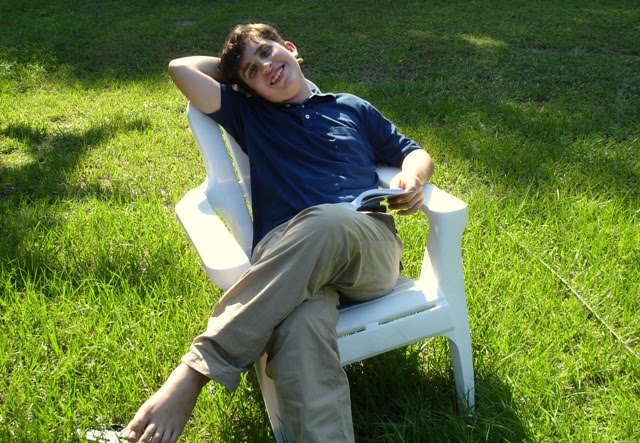
Check out what Michael's idea is regarding piano practice.


Wednesday, September 15, 2010

Wordless Wednesday - Recess

Recess
                              Happily linking with You Capture.

Tuesday, September 14, 2010

School is Outdoors Again and New Science Curriculum

We are finally nearing the end of the sweltering summer days and enjoying doing some of our school outdoors.  During the fall season, Michael can enjoy reading and journaling out by the chicken coop, doing double duty while the chickens are out grazing.  Predators stay away when they see us out there.  Come February, he will have to spend most of his time indoors avoiding oak pollen and miserable allergies.  The best time of the year for him begins now, from September through January.  He loves it out there.

I think every year, about a month after school starts, I discover that one of my subjects is not working for us.  This year, it was my science plan for Emily and Michelle.  Thankfully, it didn't take me long to find a good option.  I discovered RSO - REAL Science Odyssey.  It's perfect.  It is age-appropriate for them, with lots of hands on activities, good structure, a variety of resources, using simple materials - and they love doing school together.  It uses a classical approach to teaching, which is something I really like as well. I looked through it last weekend, and we started working on it yesterday.
Looking for living things on her plot

For today's lesson, the girls had to do a "plot study."  They each got a designated area on the yard and a magnifying glass to look for living and non-living things.  We had discussed and done a lab yesterday about what the differences are between the two.  RSO integrates nature journaling into its lessons, another thing I like about it.  So, they made their observations, we talked about some of the differences in their locations and whether they would find those same things in a different ecosystem.  They are learning a lot of new vocabulary.  I couldn't be happier!

When I got the book in the mail, I discovered that some or all the materials can be downloaded at the Pandia Press website, so next time I order there will be no delay. 

I'm linking with Outdoor Wednesday

Monday, September 13, 2010

Menu Planning - September 13

I think one of the things that is the easiest to do and gets overlooked in my routine is menu planning.  I actually enjoy doing this chore, and it really helps to know first thing in the morning what I'm serving for dinner.  I'm working on making weedly menu planning a habit.  After a day of schooling, it's nice to know I have all the ingredients I need for dinner, everything thawed out... so planning before going to the grocery store helps too.  I like going to the grocery store on Fridays and even early on Saturday mornings.  It seems like the produce is fresh on those days.

This week's plan with links and a recipe:

Monday: Zuppa Toscana, Spinach and Apple Salad, Bacon & Cheese Muffins
Tuesday: Country Style Steak (substitute beef stock for water and skip Morton's seasoning)
Wednesday: Roast Sticky Chicken (see recipe below), beans & rice, Easy Indian Style Okra
Thursday: Leftover Buffet
Friday: Linguini with tomato-almond pesto, salad
Saturday: Garden Vegetable Quiche, salad
Sunday: Thai Chicken,

Snacks: peanut butter cookies

My family loves this Sticky Chicken recipe. I've been making it for years. It is the juiciest chicken, probably because of the lower temperature and longer baking time.

ROAST STICKY CHICKEN

1 large chicken -- roasting
1 cup onion -- chopped
1/2 teaspoon black pepper
1/2 teaspoon garlic powder
1 teaspoon white pepper
1 teaspoon thyme
1 teaspoon onion powder
1 teaspoon cayenne pepper
2 teaspoons paprika
4 teaspoons salt

In a small bowl, thoroughly combine all the spices. Remove giblets from chicken, clean the cavity well and pat dry with paper towels. Rub the spice mixture into the chicken, both inside and out, making sure it is evenly distributed and down deep into the skin.  When ready to roast chicken, stuff cavity with onions, and place in a shallow baking pan. Roast, uncovered, at 250 degrees F for 5 hours. The pan juices will start to caramelize on the bottom of pan and the chicken will turn golden brown.

If the chicken contains a pop-up thermometer, ignore it. Let chicken rest
about 10 minutes before carving.

Friday, September 10, 2010

History Timelines

I've used several types of timelines to illustrate the passage of time to the kids.  The first timeline we did my first year of homeschooling was one many homeschoolers like, a long strip of connected sheets of paper pinned to a wall.  We added figures and dates to it as we went along.  Then, one day, I was looking at the discount shelves at Barnes & Noble and discovered The Wallchart of World History (Revised): From Earliest Times to the Present - A Facsimile Edition I think I paid less than ten dollars for it!  It was a great find.  We stretched it out in on the floor and spent hours looking at all the intricate lines, names, dates, colors...  We still use it and like it, specially because I can fold it back up and put it away! 

The long timeline on the wall ended up not holding up very well over time.  So, I decided that since we liked the old World Chart book so much, we would have our timelines in a notebook.  

The timeline chart has lots of useful information besides the long list of dates, events, and people.  It inclundes maps showing where those events happened too.  I also like that it begins with Adam and Eve and doesn't include politically correct history for the beginning of time - a rare find.  This edition isn't in print, but there are still some available for sale.

This week, Michelle started her own timeline notebook. She loves coloring the pictures, glueing them, and seeing how events progress along the line.
Building a timeline doesn't need to be expensive.  I use the History Through the Ages figures because I met the lady who makes them and just love her art.  For our pages, we used Donna Young's timeline charts on nice, heavy paper.  I also plan on having some of Michelle's own art work in the timeline.  I think it makes it more personal, plus I think Michelle is a pretty good artist too!

If all goes according to plan, Michelle will be done with history, from Antiquity to Modern times, in four years.  I plan to have her timeline bound into a book then.

Tuesday, September 7, 2010

Nature Journal - Native Florida Wildflowers

Summer Wildflowers
On our nature walk today, we went out looking for wildflowers around our house.  We like them because our bees do, and we are all for feeding the beehive, as we look forward to our first honey harvest.  We saw the bees feeding on Spanish Needle, the ones in the vase with the white petals.  Last spring, I planted some Blanket Flower seeds which have grown and multiplied all summer around a bird bath.  Those are the big ones with orange and yellow petals. 
"Skunk Flower"
The girls love going out and making a little bouquet of wildflowers.  They are learning the names and uses of many of them, if we can find them in our nature guides or online.  There are some we haven't found yet, mystery flowers like the "Skunk Flower" named by Emily who claims they smell just like a skunk.  We took her word for it and didn't get too close. 

Emily's Wildflowers
Learning how to use a nature guide to identify a plant is a valuable skill to have.  It teaches them how to do research on a particular subject, where to find the information, and what kind of information is available to us either on our own bookshelves, at the library, or online.  When they learned that bees are attracted to some of our native wildflowers for food, they understood better why it's important to allow wildflowers to grow along with our roses and other ornamentals.  We studied the importance of making sure we don't destroy the balance of God's creation by carelessly putting out chemicals that harm other creatures.

Sketching the flowers draws their attention to details.  I saw Emily counting the petals on one of the flowers, so she could get them just right on her picture, and she realized that not all flowers have the same number of petals.

Michelle's Wildflowers
 She then read a short paragraph with my help about flower visitors from Usborne Complete First Book of Nature (First Nature) which reinforced our lesson and gave her some reading practice that was a little more advanced and challenging than what she gets form her 1st grade curriculum.  After that, she recited back to me what she remembered from her reading, that helped cement the information, I copied it down, then she took my paper and re-copied it on her nature journal; which gave her more practice with reading and writing.

The girls love doing some of their work together, and nature journaling gives them a chance to learn and share an activity.  When they sit down to do their drawing, I don't let them see each other's work, as they tend to copy each other.  I tell them that I love both their styles and drawings, and that it would be boring for me if they gave me two identical pictures.  I know that Michelle is more advanced than Emily and has had more art lessons, but Emily's has a style of her own that I would want her to develop and not stifle away. 

Nature journaling is a very well-rounded and rich learning activity with opportunities to integrate many subjects - reading, writing, art, history, bible... and of course science!
We also watched a beautiful (and educational) video filmed by the Florida Wildflowers Growers Cooperative.


I participated in The Wednesday Window Linky!
Photobucket

Monday, September 6, 2010

Baking Cakes

One of the things most homeschooling moms have to do is learn to be frugal. Living on one income has forced me to learn how to do many things myself instead of just buying them ready made, especially in the kitchen. We also try to eat as healthfully as possible, so that has also lead us away from eating out as much as we used to.  And, frankly, I just prefer homemade food over what most restaurants serve.  I have an MSG intolerance that has taught us that most restaurants load up on it, and MSG isn't good for anyone; so that's another reason to stay away, besides the need to be frugal.

I don't do hardly any baking during the summer, mainly because I don't want to heat up the house with a hot oven.  Come September, I am missing baking and cooler weather very badly.  So, I start baking, even though we'll probably not get the first cold front till mid-October.  I am a cool weather girl and love our winter weather.  So, Labor Day weekend begins baking season at my home.

We had guests for dinner on Saturday, so I decided to risk trying a new cake recipe.  I just couldn't wait.  I'd been reading up on cake baking tips, looking to improve my skills.  Two pointers I followed: all ingredients should be at room temperature and sugar and butter should be mixed for 10 minutes minimum.  It worked! I also learned how to put a chocolate ganache by watching a YouTube video. It was pretty easy!

Gold Cake

1 1/2 cups sugar
12 tablespoons unsalted butter
2 1/2 cups unbleached all-purpose flour
1 1/2 teaspoons baking powder
1/2 t salt
6 eggs
2 teaspoons orange extract
1 teaspoon vanilla extract
1 cup buttermilk

Preheat oven to 350 degrees.  Butter and flour two 2x9" cake pans. 
Beat butter and sugar for 10 minutes, minimum; then add one egg at a time till thoroughly incorporated intot he batter. While this is beathing, mix the rest of the dry ingredients in a separate bowl.  Add extracts to the butter mixture, then add flour and buttermilk alternating four times with flour being the first and last ingredient to add.  Bake for 30 minutes or until a toothpick inserted in the middle of the cake comes out dry.  Cool in pans for 10 minutes. 

If you are using a ganache, cakes must be fully cooled and preferably refrigerated.  Cover with plastic wrap to refrigerate after cooling.

This video helped with how to pour the ganache.
Related Posts with Thumbnails