I have no greater joy than to hear that my children are walking in the truth. 3 John 1:4

Monday, November 1, 2010

Learning About Bees & Honey

xhoney14The big excitement at our home the last few days has been our honey harvest of this weekend.  We got our first beehives back in April and had been anticipating the day we would get to taste their honey.  This weekend was it. 
xhoney4

We had friends over and made a fieldtrip out of it, and we are taking a  break from our regular science curriculum to work on a bee unit.

I found a complete, free honeybee lapbook at Homeschool Share. 

We watched Moody's City of Bees video and read library books about bees.
xhoney2

I had fun drawing on the board while explaining the parts of the bee and the shapes of the cells in the honey comb.  The girls used my board sketches to draw copy their own pictures for bee cover pages for their lapbooks.

lapbook

We also watched this nice video about queen bees.


Follow the link to read more about our honey harvest.

These are the books and video we used for our bee study.


Now you can go visit the Homeschool Chick's Hip Homeschool Hop and see what other homeschoolers are doing this week.

Monday, October 25, 2010

Science - The Circulatory System (BLood)

In our lesson about the circulatory system last week, the girls enjoyed a neat experiment that helped them learn the parts and functions of blood.

xblood

The large Red Hots candy pieces, lentils, and fava beans were perfect substitutes representing platelets, red and white blood cells.  Corn syrup held them all in suspention as blood plasma.  The experiment even caught the attention of my two older ones who happened to be around at the time. 

I'm linking with Hip Homeschool Hop.  Go see how other homeschoolers are learning!

Thursday, October 21, 2010

Nature Journal - Purple Sea Urchins

On our trip to Cayo Costa, last week, we found dozens of (dead) sea urchins strewn all over one section of the beach.  We brought home a few to add to our collection of shells and other beach finds and to learn more about them.  We wondered why so many would be washed up to shore, most of them with all their spines but some without.  They look like works of sea art.

We learned that the sea urchin have been categorized in a Phylum called Equinodermata, which means spiny skins.  They are grazers and like to eat algae.  They aren't very sophisticated animals though, as they don't have a brain at all.

In Japan, sea urchin roe, which they call 'uni', is considered a delicacy and costs over $200/lb.!  It turns out that California exports tons of sea urchin roe to Japan.  Who knew? 

All this was an opportunity to discuss a little geography to see where Japan is on the globe and how long it would take to fly a case full of sea urchin roe over there.

xsea urchins

Emily focused on what the sea urchins like to eat and who likes to eat them... I'm wondering if she was hungry when she wrote that.  Also, see the little fish with the sad face?  I think she was the little fish and that was her view of the waves!  She was, true to her personality, very cautious about those waves and swimming in general.


We also watched this wonderful BBC video showing an army of sea urchins mounting its attack on the kelp forest off the coast of California.


Linking with Friday Blog Hop and Friday Follow.

Wednesday, October 20, 2010

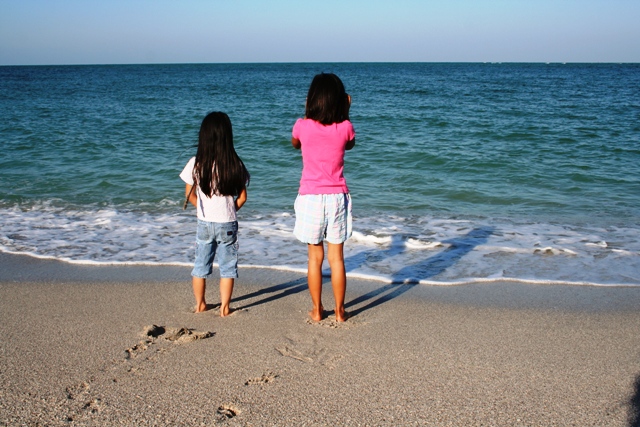
Wordless Wednesday - The Girls


I'm linking with:
Wordless Wednesday @ Home Grown Families       Wordless Wednesday @ The Florida Hogans
Wordless Wednesday @ Homeschool Reviews       Worldless Wednesday @ Grammy Mouse Trails
Wordless Wednesday @ Shibley Smiles

Tuesday, October 19, 2010

Field Trip to Cayo Costa

I thought I'd share some of the pictures from our trip to Cayo Costa, and it has been hard to pick just a few.  We had a really good time!  The weather was perfect, the beach was beautiful, the trails were interesting and beautifully kept.

 We had the beach to ourselves most of the time.  There are miles of beaches there, and because the island is only accessible by boat, there aren't many people there.
 The kids swam from morning till evening....
There were dozens of different types of birds around us all the time.


We enjoyed taking hikes on the trails, discovering new native plants, and even a pioneer cemetery...

Pioneer Cemetery
 There were no letterboxes in Cayo Costa, so we planted one near the cemetery.  Letterboxing is one of our favorite things to do together.  We've discovered many interesting places in our letterboxing expeditions.  Letterboxers like to lead you to beautiful, out-of-the-way sites that are not well advertised, and Cayo Costa fits that description well.

Michael's first catch
 The beach was teeming with fish...  We saw large schools of them jumping out of the water.  We caught enough to make a meal out of them.
Cabbage Palm (Sabal palmetto)- Florida native, source of edible swamp cabbage
See our cabin in the background?


 I took this picture when we were about to leave.  We had a hammock on the porch and a few chairs, plus towels hanging on the line which provided shade in the afternoon.  The cabins are rustic, with three bunk beds and a picnic table inside.  There is no electricity or running water in the cabins; however, there are bathrooms and showers available there.

Osprey - sea hawk or fish eagle
  Did I mention the bird population?  We watched as the ospreys, pelicans, and seagulls fished their meals out of the water.

Scrub Morning Glory Bonamia grandiflora
Native wildflowers decorated the landscape.  These morning glories were scattered everywhere.  They are an endangered species.  It was good to see how the rangers have been taking care of this island and its native plants and animals.  Maybe this is what the entire state of Florida was like just 100 years ago. 

wild coffee (Psychotria nervosa)
There were numerous cacti and sea grapes with their edible fruits along the trails. We also found several wild coffee bushes, like this one, loaded with berries.

One of the things Cayo Costa  is known for is the abundance of shells along its beaches, and it didn't disappoint.  The girls came home with a big bag to add to their collection.  They also found many sea urchin shells, which they will be writing about in their nature journals this week.

We never caught sight of Ol' Henry, but that's not a bad thing.  We've already made reservations to go back  next year!

Here are my top ten favorite things about Cayo Costa:

1. It is remote - This means less crowds, noise, pollution, and more wildlife
2. The wildlife - It was like being on a safari...
3. The combination of beach and hiking trails - It gave us two very different things to do
4. It is a state park - there is always a park ranger on call
5. It was close to home - Only a three hour drive
6. It was inexpensive - Even though we had to pay the ferry which added to the cost...
7. The cabins - I don't really like tent, trailer, or RV camping.  RV camping generally means generator noise, plus it usually brings crowds
8. Privacy - The cabins had lots of space between them.
9. Great fishing
10. Nice beach - clear water, lots of shells, calm waters...

I'm linking with Hip Homeschool Hop, and Top Ten Tuesday today.

Wednesday, October 13, 2010

Gasparilla Island Weekend

I've been busy this week getting ready for a four-day adventure.  The kids are beyond excited.  We've reserved a small cabin at Cayo Costa State Park, off the coast of Florida, just about two hours south of us. The entire island is part of the Florida State Park system and can only be reached by boat.  I expect there will be very few people there tomorrow and Friday, since only one other cabin has been reserved for those days.

The island has miles of isolated beaches, famous for great shelling and natural beauty. We'll be shore fishing, star gazing, cooking out, swimming, biking, hiking, going on a guided beach walk with the park ranger, bird watching, and of course -  collecting shells.  The kids are super excited about our little adventure. You see, Cayo Costa, also known as Gasparilla Island, has an interesting history...  The island was named after the pirate Jose Gasper, who settled on the island in the 1700s with his pirate friends. They used the island as their cove.  Legend also has it that there is a big shark called Old Henry who roams about at dusk...

The weather forecast looks great... 


We will be out of range for the next few days - no phones, computers, tv...  just a park ranger to connect us with the mainland in case of emergency. 

Go to Outdoor Wednesday to see what others are doing in the great outdoors and come back next week to see the pictures!

Friday, October 8, 2010

Enjoying our Library and its Books

Last week at the Brandon Library
During my 12+ years of homeschooling, I have checked out hundreds of library books. We have relied on our public library to supplement our school with books, educational videos, magazines, software, and other resources. Once in a while though, I miss my deadline AND my one week grace period; then I have to pay the dreaded fines. It used to be that we had a $1.20 maximum fine per late item, but that has amount has almost doubled since our county made large budget cuts. Still, we love our library and continue to benefit from it. To avoid late fines, I’ve used the free daily email notices from Library Elf. This has been very helpful, though once in a while one will slip past me, like this week. Library Elf also notifies me of the status of my holds and if one is about to expire.
My children have grown up using the library, and I’m sure will continue to do so as long as they remain open to us. A visit to the library is a highlight for them, they jump at the opportunity to go. They know that not every book at the library is appropriate for them. I’ve trained them to show me the books they are interested in, so I can tell them if they may read them.

One of the resources I use to decide which books they can read is Who Should We Then Read by Jan Bloom. It is my reliable source, a goldmine, of more than 150 authors. Jan Bloom is a veteran homeschooler. She and her husband homeschooled their children into college beginning in 1988.

Considering the number of years we've been checking large numbers of books out  (sometimes up to 30+ books at time), we've had few fines and losses.  We have a couple of rules regarding library books, one is that they should always be put back on the designated library book shelf.  Looking for a book that has been placed on a regular book shelf, we've learned, can be like looking for a needle in a haystack - not something we like to do.  The other rule is that library books don't leave the house unless they are going back to the library.. Another thing I try to do is to return our books directly at the check-out desk and have the librarian give me a receipt.  We've had several instances when books were returned and did not get checked in, this has helped ease that problem.

Another thing we like to do periodically is check out the shelves in the Friends of the Library book store.  Our library has a room dedicated to selling books that are either being pulled off the shelves or have been donated to them.  I've found some great treasures on those shelves at bargain prices!

This afternoon, we'll be heading over to drop off books and pick up holds.  It's such a pretty fall day that we'll not spend much time indoors, but we'll bring home some good reads and enjoy the best benefit the library has to offer - a much richer understanding of the things we are learning about in school, gardening books with lots of ideas to improve ours with, interesting cookbooks with new recipes to explore, and much more...

I'm linking with Friday Blog Hop today!
Related Posts with Thumbnails